GLOBAL INSTITUTE OF PROJECT MANAGEMENT,AFRICA

Blog
The Cobra Effect: Lessons in Project Leadership

The Cobra Effect: Lessons in Project Leadership

When Killing Cobras Makes You Breed Them—A Lesson in Project Leadership

During British colonial rule in India, the government launched what seemed like a brilliant solution to a pressing public safety issue: the streets were overrun with deadly cobras. The government offered a bounty for every dead cobra turned in.

Initially, the program worked. Snake populations dropped, and the streets seemed safer.

However, soon some enterprising individuals discovered a loophole: they began breeding cobras solely to kill them and collect the reward. When the government realized what was happening and shut down the program, the breeders released the now-worthless snakes back into the wild, making the original problem even worse.

This phenomenon became known as “The Cobra Effect”—a powerful lesson in how well-intended solutions can lead to bigger, unintended problems.

What the Cobra Effect Teaches Project Managers

In project management, the Cobra Effect is more than just a historical anecdote—it’s a cautionary tale. Projects often involve quick decision-making in fast-paced environments. But when decisions are made reactively, without considering the long-term impact, those decisions can backfire in unexpected ways.

Real-life Examples:

1. Cutting corners to meet a tight deadline: This might seem like a practical solution at the time, but it often leads to costly rework later.


2. Incentivizing speed over quality: You might hit your deadlines, but at the cost of your reputation and customer trust.

3. Centralizing decision-making to reduce risks: While this may seem like a way to gain control, it can stifle innovation and slow down project velocity.


Each of these decisions may appear logical in the short term, but they fail to account for the unintended consequences that can arise down the road. Much like the Cobra Effect, the solutions to one problem might end up creating an even bigger challenge.

How to Outsmart the Cobra: Use IF/THEN Thinking

One tool that can help project managers avoid the Cobra Effect is IF/THEN thinking. Originally borrowed from software development, this approach forces you to anticipate how different actions will lead to different outcomes.


Example Scenarios:


IF I skip stakeholder consultation to save time, THEN how will this affect project buy-in and future support?


IF I add more approval layers to reduce risk, THEN what will be the impact on project velocity and decision-making speed?


IF I reduce the budget for team training to cut costs, THEN what impact will that have on delivery quality and team performance?


This framework helps you think beyond the immediate benefits and assess the broader system that your project operates within. By asking “what happens next?” you can make better decisions that anticipate and mitigate risks before they become issues

Smart Decisions Aren’t Always the Fastest—They’re the Wisest

As project leaders, we’re often judged by our results. However, true leadership involves understanding not just the immediate effects of your decisions, but also the second- and third-order consequences.


Quick wins may look good in the short term, but they often come at a cost. Instead of focusing on fast fixes, invest in decisions that are strategic, sustainable, and stand up under pressure—decisions that don’t unravel when circumstances change.

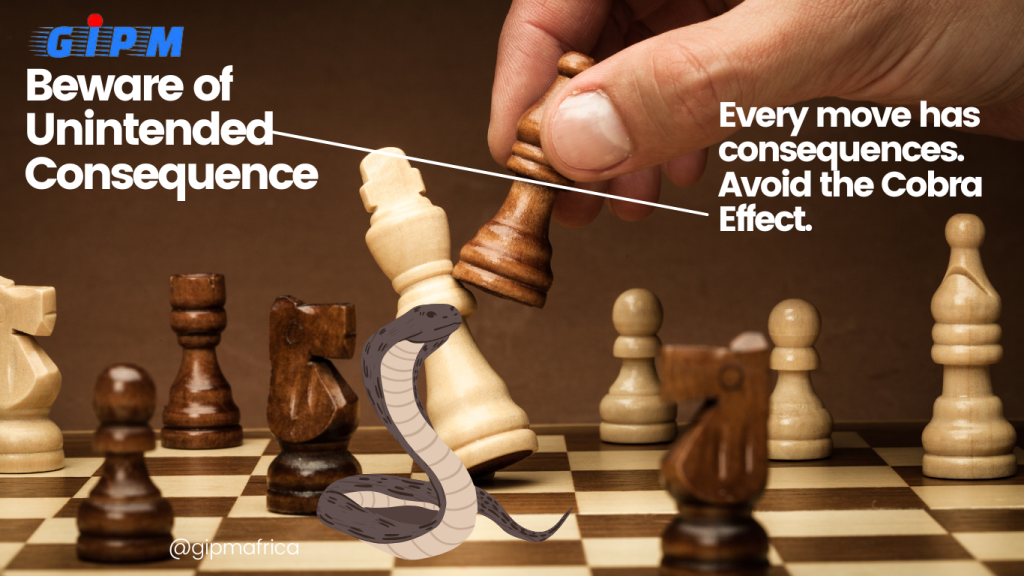
Your Project Management Road Sign: “Beware of Unintended Consequences”

Next time you face a challenge that seems to demand a rapid solution, remember the Cobra Effect. Pause and ask yourself:

> “Am I solving the real problem—or just reacting to the symptom?”

This simple question can help ensure that your decisions are based on understanding the broader picture and not just on temporary fixes.

Real-life Case Study: A Project Management Cobra Effect

Example: In a recent software development project, a company incentivized its team to complete features faster, offering bonuses for early delivery. While the team hit the targets, the rush led to untested, subpar code that resulted in bugs, rework, and client dissatisfaction. The short-term reward created long-term consequences.

Be a Chartered Project Manager 


Discover more from GLOBAL INSTITUTE OF PROJECT MANAGEMENT,AFRICA

Subscribe to get the latest posts sent to your email.

Leave a Reply

Your email address will not be published. Required fields are marked *

Discover more from GLOBAL INSTITUTE OF PROJECT MANAGEMENT,AFRICA

Subscribe now to keep reading and get access to the full archive.

Continue reading