GLOBAL INSTITUTE OF PROJECT MANAGEMENT,AFRICA

Project Management & Leadership
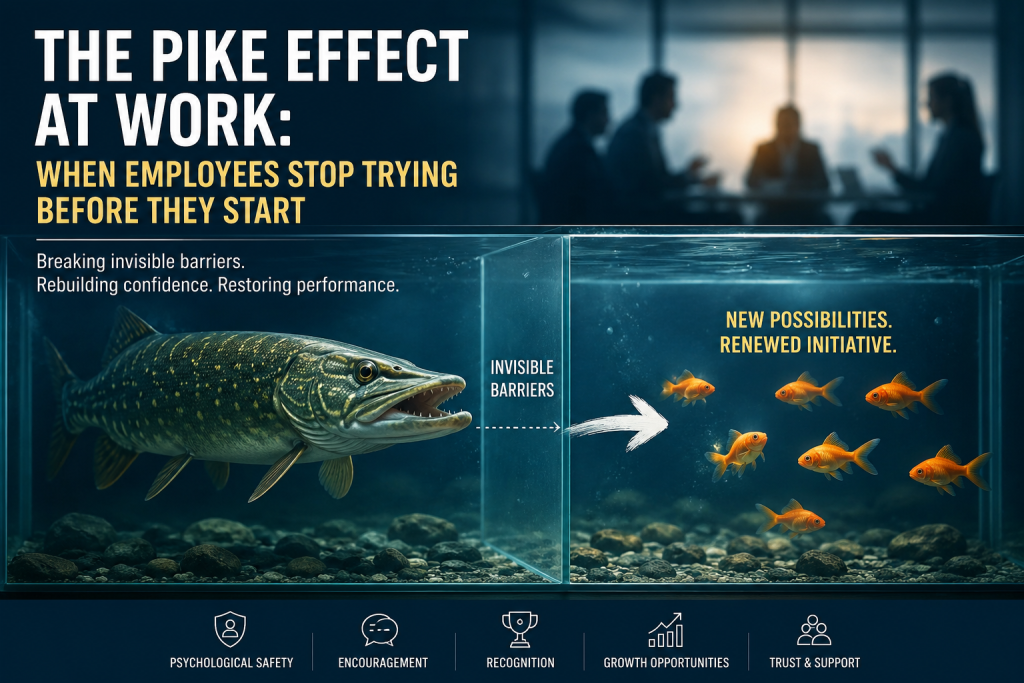
The Pike Effect at Work: When Employees Stop Trying Before They Start

The Pike Effect at Work: When Employees Stop Trying Before They Start

In many workplaces today, the greatest limitation is not lack of talent, technology, or opportunity.
It is something far more dangerous — conditioned discouragement.

A brilliant idea remains unspoken in a meeting.
A talented employee avoids leadership roles.
A worker stops proposing improvements because “nothing ever changes here.”

This silent organizational condition can be explained through a powerful psychological concept known as The Pike Effect.

Understanding the Pike Effect

The Pike Effect originates from a behavioral experiment involving a predatory fish called a pike.

The pike was placed in a tank with smaller fish separated by a transparent barrier. Repeatedly, the pike attempted to attack the fish but hit the invisible barrier each time. Eventually, it stopped trying.

The shocking part came later.

Even after the barrier was removed, the pike still refused to attack.
The limitation was no longer physical — it had become psychological.

In many organizations, employees unconsciously develop the same response.

The Modern Workplace Has Invisible Barriers

Many workers enter organizations with energy, creativity, and ambition. But over time, repeated experiences can silently “train” them to reduce effort.

Examples include:

  • Ideas constantly ignored
  • Promotions perceived as unfair
  • Leaders who discourage initiative
  • Fear of punishment for mistakes
  • Toxic criticism without recognition
  • Micromanagement
  • Lack of growth opportunities

Eventually, employees stop trying — not because they lack ability, but because they have learned that effort appears meaningless.

This is the corporate version of the Pike Effect.

When Skilled Employees Become Emotionally Disengaged

One of the greatest mistakes organizations make is assuming disengaged workers are lazy.

Sometimes:

  • The quiet employee was once innovative
  • The passive supervisor was once ambitious
  • The resistant worker was once enthusiastic

But repeated disappointment can create emotional withdrawal.

The employee is physically present but mentally disconnected.

This is why some organizations have:

  • High attendance but low productivity
  • Experienced staff but poor innovation
  • Large teams but weak initiative

The real problem is not competence.
It is conditioned hopelessness.

The Leadership Question Every Organization Must Ask

“What invisible barriers exist inside our workplace culture?”

A capacity-building organization must understand that learning does not only involve technical skills.

People also need:

  • Psychological safety
  • Encouragement
  • Recognition
  • Trust
  • Freedom to contribute
  • Opportunities to fail and improve

Without these, training alone may not transform performance.

Breaking the Pike Effect in the Workplace

Organizations that want high-performing teams must intentionally remove psychological barriers.

1. Create a Culture Where Ideas Are Heard

Employees become more engaged when they believe their voice matters.

Even when ideas cannot be implemented, respectful feedback keeps participation alive.


2. Reward Initiative, Not Just Results

If workers are punished every time they fail, they eventually stop attempting new things.

Healthy organizations reward:

  • Creativity
  • Effort
  • Problem-solving
  • Responsible risk-taking

Innovation grows where fear reduces.


3. Develop Leaders Who Inspire Confidence

Managers should not merely supervise tasks.

They should:

  • Build confidence
  • Encourage growth
  • Mentor employees
  • Create hope during difficult periods

A single discouraging leader can create ten disengaged workers.


4. Invest in Continuous Capacity Building

Training should not only improve competence; it should restore belief.

Employees need reminders that:

  • They can grow
  • They can improve
  • They can lead
  • Their contribution matters

Capacity building is not only about knowledge transfer.
It is about unlocking human potential.

The Most Dangerous Employee Is Not the Unskilled One

The most dangerous employee is the one who has stopped believing improvement is possible.

Because once people become psychologically conditioned to failure, they begin to:

  • Avoid responsibility
  • Resist innovation
  • Fear change
  • Reject opportunities before trying

Organizations then lose productivity silently.


Discover more from GLOBAL INSTITUTE OF PROJECT MANAGEMENT,AFRICA

Subscribe to get the latest posts sent to your email.

Leave a Reply

Your email address will not be published. Required fields are marked *

Discover more from GLOBAL INSTITUTE OF PROJECT MANAGEMENT,AFRICA

Subscribe now to keep reading and get access to the full archive.

Continue reading